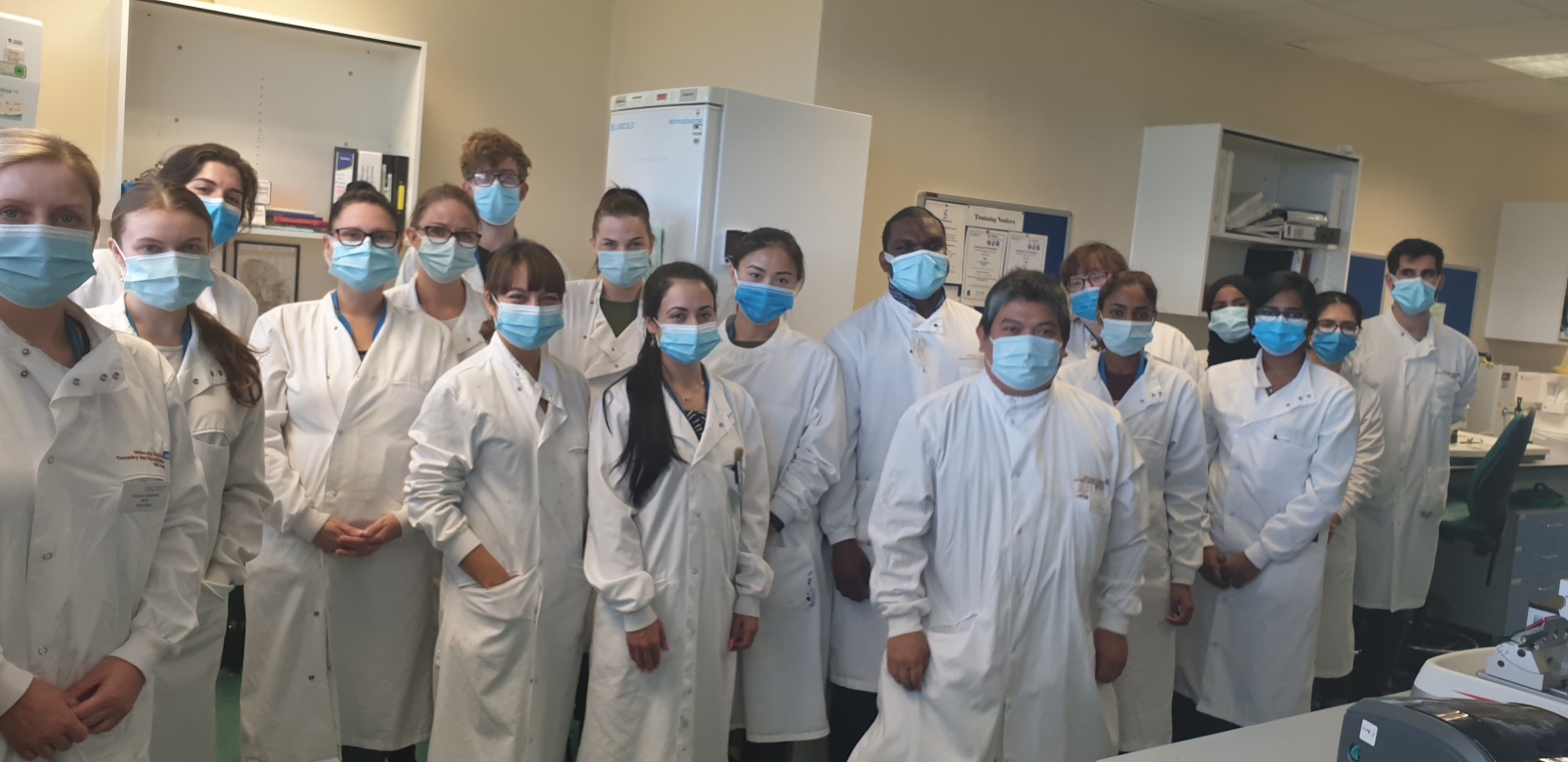
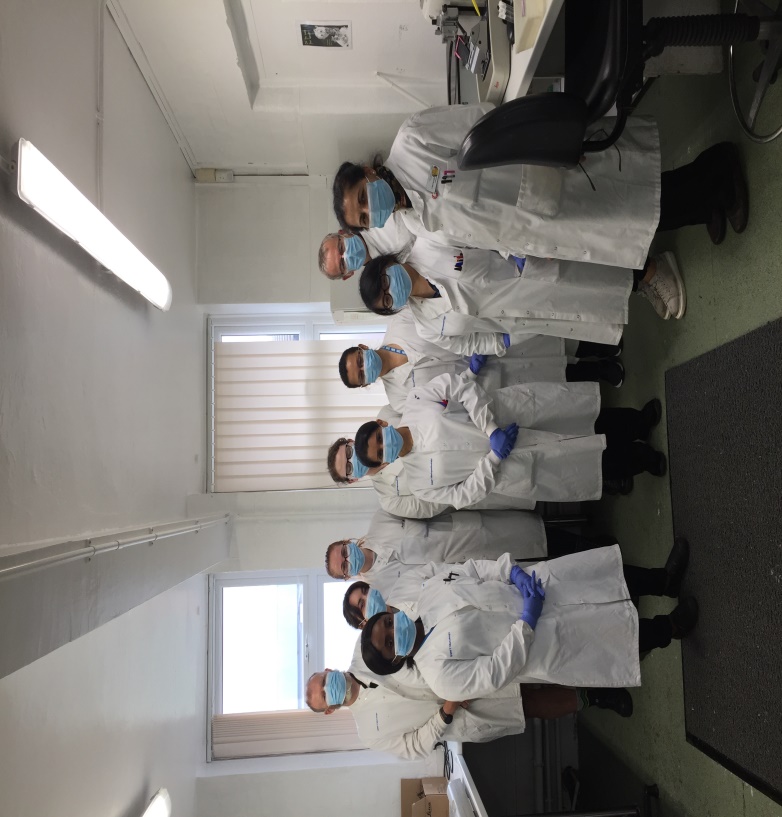
Histology: Hello from the other side of the laboratory
As CWPS staff, many of us probably work or have worked, in close proximity to a Histology Lab. You may have wondered, what exactly happens in Histology Lab?
I worked as a BMS in Blood Sciences for almost 10 years, before I decided to change discipline and career path. For several months I was unable to answer this question with confidence. It was not until I understood the basics and routine that I truly appreciated not just the field but also the staff.
Tissue that we receive in Histology Lab can range anywhere from large surgical specimens to small biopsies only millimetres in length. Either way, every specimen needs to be placed in a fixative which is most often formalin (hence the strong smell!)
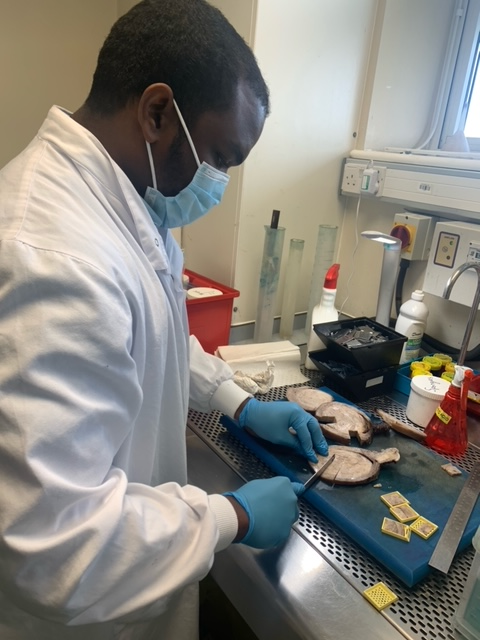
Samples are booked-in then examined macroscopically by a competent member of staff. This is referred to as grossing. Larger samples are cut into smaller pieces (about the size of a coin) and placed into tissue cassettes. At this point, BMS and BMA typically take over and complete the four main tasks: processing, embedding, microtomy and staining

Processing involves ultimately removing the water from the fixed tissue and having it infiltrated with wax which makes it easier to cut in thin slices. Once the tissue is processed, BMS or BMA removes them from the cassette and embeds the tissue. This is the step where the tissue is placed in a mold, completely filled with warm wax. This I find interesting as it is crucial for the BMS or BMA to orient the specimen correctly in the mold. Incorrect orientation will make it difficult or sometimes impossible for the Pathologist to determine a diagnosis. “Incorrect orientation will make it difficult or sometimes impossible for the Pathologist to determine a diagnosis.”

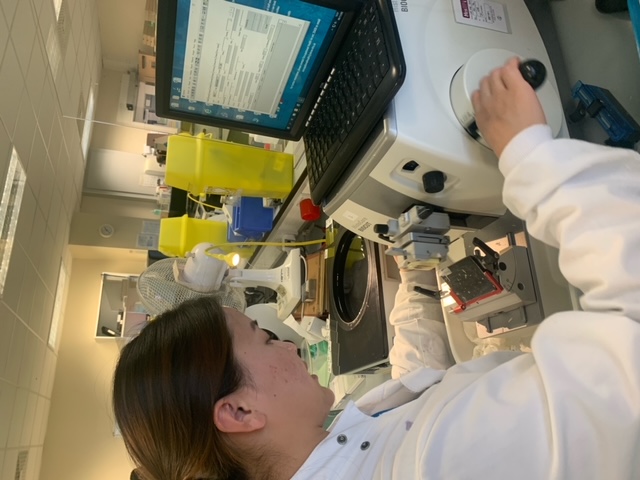
The mold is then cooled, the wax hardens which forms a support around the tissue making it easier to cut. The excess wax is removed (called “trimming”), and the resulting block is then ready for microtomy. This is when blocks are placed within a specialised tissue slicer called a microtome. Competent staff rough cut into the tissue and make sure all areas of the tissue are exposed before cutting thinner slices for analysis. This is where I find it amazing to watch – when staff cuts the tissue a ribbon is formed between each slice. This ribbon is placed in a water bath to flatten and then it is picked up on a slide. Slides are then allowed to dry and are ready for staining. We use a Haematoxylin and Eosin stain for general Histology. Some slides are also stained with different special stains to look for microorganism or connective tissue. Some slides are also stained with an antibody reaction in Immunohistochemistry to show different tumour types and help direct treatment. Stained slides are then forwarded to the Pathologist for reporting.
This for me is the routine day-to-day basis in a Histology Lab. If you’re from Blood Sciences, you may have noticed that there is less automation involved in the whole process. This makes Histology very different from the other disciplines in Pathology. I have no favourites but I can really say that Histology truly is a good mix of very hands-on work, less automation and a lot of troubleshooting. The end result – looking down at the microscope seeing those different lovely colours is truly a combination of an art and a science!
Next time you walk past by the Histology lab – don’t be shy to simply stop and say hello from the other side of the laboratory!!
Leslie Ramos
CWPS Cellular Pathology Quality Manager