Haematology
Haematology is the specialty responsible for the diagnosis and management of a wide range of benign and malignant disorders of the red and white blood cells, platelets and the coagulation system in adults and children
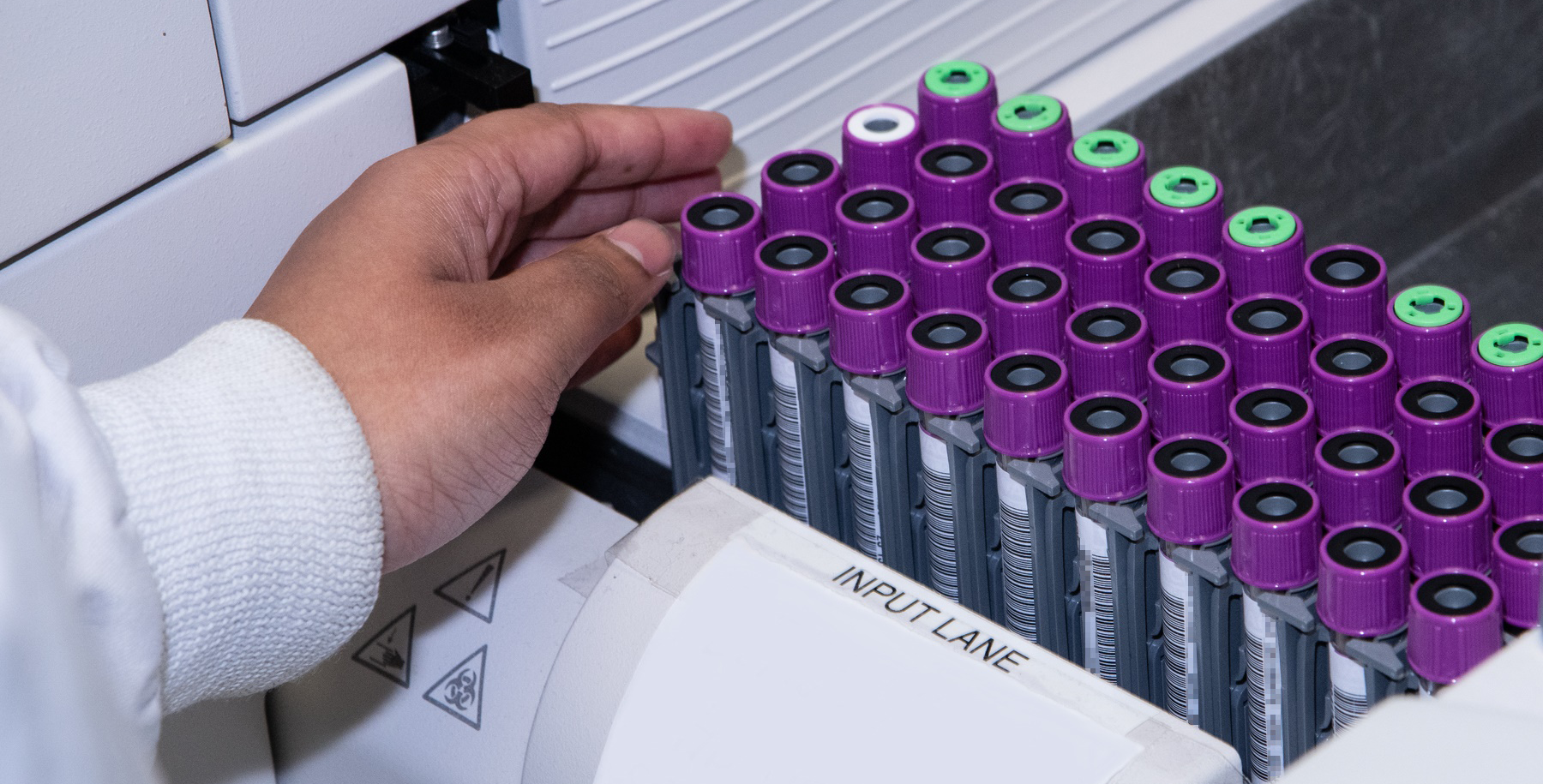
Haematology performs full blood counts and secondary testing to assist in the diagnosis and treatment of various disorders. Our Haematology laboratories also offer additional tests to identify specific conditions, eg. malaria screening, infectious mononucleosis, and reviewing blood film morphology. Our laboratories have access to specialist haematologists to assist in the diagnosis and treatment of complex haematological disorders.
Our Special Haematology department offers screening tests to identify disorders of haemoglobin production, eg. sickle-cell disease and thalassemia. Further advice about haemoglobinopathy testing is available from Haematology Consultants.
Coagulation performs clotting screens for pre-operative and routine cases. Coagulation can provide tests for prognostic markers of deep vein thrombosis and the controlling of anticoagulant therapy. The Special Coagulation department offer investigations of abnormal bleeding and clotting disorders, using the latest analysers and techniques:
Click here to view Haematology test database
All counts including differential white counts are performed by automated machines. Examination of blood films is only performed when indicated by information on the request form or from the automated count.
Emergency counts are also performed on automated machines. The result (at least a provisional one) will usually be available on the hospital clinical results system as soon as it comes off the laboratory analyser. It will only be phoned if it is significantly abnormal (see section on phoning results).
ESR is measured on the standard FBC sample, but please ensure the bottle is full.
The laboratory employs Capillary Electrophoresis to screen for abnormal haemoglobins and thalassaemia. Abnormalities are confirmed where necessary by Hb electrophoresis, or DNA analysis at the National Reference Laboratory in Oxford. Please check whether a patient has been tested previously at this hospital before requesting a test.
Sickle cell disease/trait
For urgent pre-operative cases, a ‘Sickle screen’ should be requested. This will detect the presence of HbS but does not distinguish sickle cell trait from sickle cell disease. These test results are always confirmed by more complete Haemoglobinopathy testing. Please indicate on request form date and time of operation.
Thalassaemia
Thalassaemia will not automatically be tested for in patients with low MCVs, most of whom have iron deficiency. However, we do suggest that the patient should be tested, therefore the requestor needs to send another sample after obtaining consent from the patient.
In order to interpret the results of thalassaemia testing, it is important to know:
-
The iron status of the patient (please request a serum ferritin at the time of Haemoglobinopathy testing).
-
The ethnic origin of the patient (if parents of the patient are of different racial origins, please state both)
-
If the patient is pregnant, and if so what is her estimated date of delivery (EDD).
Other Haemoglobinopathies
Further advice about haemoglobinopathy testing is available from Haematology Consultants.
All bone marrow samples are taken by Clinical Haematology staff. Please discuss the request with the registrar taking referrals (bleep 1316) at UHCW or with the local consultant on call at the other sites.
Immunophenotyping is useful in the diagnosis of leukaemia and related conditions. Please discuss any requests with the senior clinical staff, to ensure that the correct panel of antigens are tested for. Samples are sent to MIRHO (Midlands Integrated Reporting for Haemato-Oncology) at Clinical Immunology Service, Birmingham Medical School for analysis.
Suspected Bleeding Diathesis: It is important to take a full history of present and past bleeding incidents and to enquire about family history and drug ingestion. A normal clotting screen does not rule out a bleeding tendency, and an abnormal screen doesn’t mean that a patient will bleed excessively (sometimes it means they will clot more than normal!).
For screening purposes the following tests are usually sufficient, PT (Prothrombin Time), aPTT (activated Partial Thromboplastin Time) and platelet count.
-
A coagulation screen should include PT and aPTTR.
-
A screen for suspected disseminated Intravascular coagulation (DIC) should include the above plus D-Dimers, Fibrinogen and a platelet count (FBC).
-
Requests for screens for inherited bleeding disorders should be discussed with a consultant haematologist.
-
Full dose standard heparin therapy is monitored by the aPTTR
-
Low molecular weight (LMW) heparin therapy does not usually require laboratory monitoring. If it does (e.g. during pregnancy, prolonged therapy in patient with renal impairment), it requires a specialised heparin assay (phone Laboratory to arrange).
-
Warfarin therapy is monitored with the INR (no need for aPTTR)
-
Further guidance on anticoagulation can be found in ‘Warfarin Guidance’ on the UHCW intranet e-library.
-
For use and monitoring of new anticoagulants, see ‘Guidelines on the use of new Anti-coagulants – Dabigatran and Rivaroxaban’ on the UHCW intranet e-Library.
Thrombophilia screening should be reserved for those patients where thrombosis is either unexpected or unusual or those with a family history of thrombosis. (For the Coventry & Warwickshire guideline on thrombophilia testing, see:
http://uhwebapps.uhcw.nhs.uk/eLibrary/filecon/download.aspx?Doc=117974&VERI=jy5cbmp5
-
Tests should not be requested in the acute phase of a thrombosis. The results do not affect the acute management and may be misleading.
-
Some tests are invalid if the patient is on heparin whilst others are invalid if the patient is on warfarin (and even up to 4 weeks after warfarin has been stopped)
-
Thrombophilia screening should not be performed in patients who are pregnant, on an oral contraceptive or HRT, as these may invalidate some test results.
Request for H.I.T.T screens should be discussed with a consultant haematologist and then arranged with the laboratory due to the specialist nature of the analysis (i.e. sample type/timing of transport). It is also necessary to assess the likelihood that the case is actually HITT (i.e. calculate a ‘HITT score’) in order to interpret the result of the screen correctly (see HITT guideline on UHCW intranet e-library) The samples are sent to Queen Elizabeth Hospital, Birmingham and if results are required urgently, it is helpful to phone the lab and discuss (see Haematology Sample Requirements table below for contact details).
D-Dimer screening must only be used as a negative predictor in conjunction with pre test probability, see below:-
Wells Score (adjusted 2003)
Before using the D-Dimer test to rule out a DVT, please calculate the pre-test probability score for DVT as developed by Wells and adapted in 2003:
| Points | |
| Active cancer (treatment ongoig or within previous six months or palliative) | 1 |
| Paralysis, plaster | 1 |
| Bed >3 days; major surgery within 12 weeks | 1 |
| Tenderness along veins | 1 |
| Entire leg swollen | 1 |
| Calf swollen > 3cm | 1 |
| Pitting oedema | 1 |
| Collateral veins | 1 |
| Previous DVT | 1 |
| Alternative diagnosis likely | -2 |
| DVT unlikely: <1. DVT likely: > 2 |
If probability is ‘likely’, do not use the D-dimer, but proceed to leg Doppler ultrasound examination. If probability is ‘unlikely’ then test D-dimer.
Follow the management algorithm below:

Dr N Jackson, UHCW, Jan 2013.
Most non-urgent routine Haematology work should be available within 4-6 hours upon receipt in the laboratory in which it is analysed.
Requests deemed as ‘urgent’ are treated as priority, and results for basic Haematology/ Coagulation investigations should be available on the ward electronic reporting systems (CRRS/Review/ICE) within 1 hour of receipt in the laboratory.
Some specialised tests may not be listed in the following table; please contact the department if you cannot find the test in the following list.
ESR, reticulocytes, manual differential, heterophile antibodies and Haemoglobinopathy testing may be added to a FBC request up to 24 hours after taking the sample.
Blood film for malaria parasites and additional coagulation tests can be only requested within 4 hours of sample collection.
Please send a new e-request or paper request form for any additional investigations.
On the first occasion, the following critical results will be automatically communicated by telephone to the requesting Clinician as soon as they are available:-
|
Criteria |
Action/Exceptions |
|
Hb <70 g/L Hb >200 g/L |
Unless renal patients / other patients with known low Hb Unless SCBU (only phone if Hb > 250 g/L) |
|
Platelets < 50 x 109/L Platelets > 1000 x 109/L |
Unless previously known. |
|
Neutrophils < 1.0 |
Exceptions – known haematology/oncology patients (all haem/onc patients- not just in patients) African-Caribbean people (unless <0.8) |
|
Malaria positive |
|
|
Presence of blasts / features of HUS/TTP/DIC |
Urgent review by on call haematology SpR/Consultant - call medical team after film review. |
|
Sickle screens - preoperative results |
Only in pre-operative emergency situations- not for pre-planned screens |
|
INR > 6.0 (Out of hours) INR > 5.0 (9-5) |
Phone medical team Alert local anticoagulation clinic (working hours). Out of working hours - alert on call haematologist |
|
APTT ratio > 3.0 |
Contact ward and confirm if patient on heparin infusion. If not on heparin infusion request repeat peripheral sample - ?heparin contamination from a line. |
|
Fibrinogen <1.0 g/L |
|
|
D dimers > 0.5 mg/L FEU |
1. University Hospitals Coventry and Warwickshire
Please refer to the following guidelines on the Trust Intranet e-Library:-
Warfarin Guidelines,
Overanticoagulation by warfarin in Adults and Oral Vitamin K, British National Formulary
2. South Warwick Hospital
Please refer to the following guidelines on the Trust Intranet:-
Anticoagulant Treatment Guidelines SWUFT 00253
Anticoagulant guidelines for peri-operative management of patients on warfarin SWUFT 00167
Anticoagulant thromboprophylaxis guidelines for adults SWUFT 00496
3. George Eliot Hospital
Please refer to the following guideline on the Trust intranet:-
Anticoagulant Treatment Guidelines