Cellular Pathology
Cellular pathology is the study of organs and tissues, and is used to diagnose illnesses and medical problems, similar to other branches of medicine, such as blood testing, radiology, blood transfusion and biochemistry. We analyse the causes of certain diseases and the effects that they are having on the body.
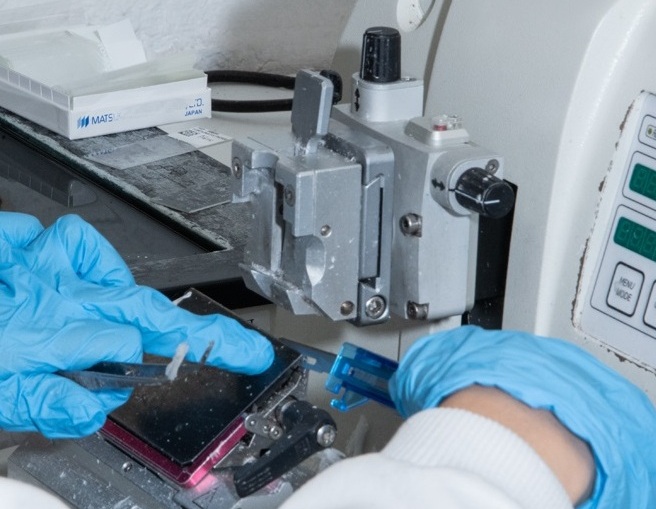
There is a Histology laboratory located at UHCW and SWH. Non-gynae cytology is received and processed at the UHCW laboratory.
There are Mortuary facilities located at UHCW, SWH and Rugby.
Samples collected for Primary HPV cervical screening testing are all sent to the West Midlands Cervical Cancer screening service at Wolverhampton Hospital.
Samples from primary care across Coventry and Warwickshire are collected by the QE Facilities courier service and transported to CWPS laboratories with other Pathology samples. The courier from Wolverhampton then collects any samples from primary or secondary care directly from pathology and transports to the regional screening lab.
Electronic reports are sent directly to GP surgeries from Wolverhampton.
For more information please see:
https://www.royalwolverhampton.nhs.uk/services/service-directory-a-z/pathology-services/departments/cytology/
https://www.england.nhs.uk/midlands/information-for-professionals/information-for-professionals-west-midlands-screening-and-immunisation-team-sit/west-midlands-screening-information/west-midlands-cervical-screening/
Location
The Histopathology (including non-gynae cytology) Laboratories are located on the fourth floor of the West Wing, University Hospital, Coventry.
There is a Mortuary on both of the Trust’s hospital sites – University and St Cross Hospitals and at George Eliot Hospital.
Service
There is a routine laboratory service Monday - Friday between 7am and 6pm.
Service
General advice on Specimens and Reports
Specimens
Enquiries regarding collection, fixation and processing should be directed to the scientific staff.
Containers
Containers for Histology and non-gynae Cytology are available in ward or theatre stores; or by contacting the appropriate laboratory.
University Hospital:
Histology Ext: 25341
Forms
An appropriate form must accompany all specimens:
Histology: Use special white histology request form only
Cytology (non-gynae): Use white non-gynae request form only
Details on the request form must include:
- Patient’s name / hospital number / date of birth / address / post code
- Referring consultant’s name
- Ward
- Date
- Specimen type(s)
- Clinical details
- Private patients must be clearly identified
Infectious Cases
Samples from known/suspected infectious cases must be labelled DANGER OF INFECTION particularly those from TB, HIV or Hepatitis cases.
Availability of Reports
Histology and Cytology (non-gynae) - The department aims to have 80% reported within 7 calendar days and 90% reported within 10 calendar days, following Royal college of pathologist guidance. Due to the complex interpretive nature of histopathology and cytology specimens this may not always be achievable.
HISTOLOGY – SPECIAL REQUIREMENTS
Fixation of routine surgical specimens
Lymph nodes fresh tissue in a dry pot urgently sent to the laboratory
Skin biopsies for immunofluorescence in normal saline
All other specimens for routine histological examination should be sent in sealed pots containing formal saline fixative, unless other arrangements have been made.
The pots may also be labelled as:
10% Formalin; 10% Formal saline; 4% Formaldehyde
*Please note that formalin is a HAZARD. It is harmful by inhalation and swallowing. Contact with skin and eyes should be avoided. There is a risk of sensitisation and suitable gloves should be worn. There is a possible risk of irreversible effects.
Specimens must be handled with care to avoid crushing or squeezing when in the fresh state, and should be placed in fixative immediately after excision.
Adequately sized containers should be used. Please do not force large specimens into small containers as this distorts the specimen and they can be difficult to remove. Sufficient formalin is necessary to fix the specimen – at least 5 times the volume of the specimen. Please ensure that the specimen containers are properly tightened and are kept in an upright position, to prevent leakage. The use of plastic specimen bags is not advised for small specimen containers as the containers cannot be kept upright and leakage can occur. Tissues and tumours are best left whole. Multiple incisions into tumours may make the completeness of excision difficult or impossible to assess.
Whenever possible, glass containers should be avoided
Identification
All containers must be labelled with the following:
- Hazard warning indicator for formaldehyde (Irritant)
- Address / Contact No. of Laboratory (in case of accident or spillage)
- Patient’s Name
- Hospital No.
- Date of Biopsy
- Hospital / Ward / Clinic
- Tissue
- Requesting Consultant / GP
Histology request form: all specimens must be accompanied by a histology request form, and the minimum information given should be:
- Full Patient ID include DOB
- Hospital No
- Date of Biopsy
- Ward / Clinic
- Tissue
- Requesting Consultant / GP
- Precise details of tissue sent including site of biopsy and relevant clinical details
If any sample is incorrectly or inadequately labelled, and/or does not have an adequately completed request card, then the specimen will normally be returned to the source of the request.
Transport
Specimen pots should be placed in a sealed plastic bag together with the accompanying form in a separate pocket.
If transporting several specimens, please use the metal tins that are provided. These tins are labelled with contact and spillage information. Further Health and Safety information sheets are available from Peter Whitney (Ext 25359)
Specimens should be delivered to the Histology Specimen Reception in the Pathology Department, Fourth Floor, West Wing University Hospital. Outside of normal hours, the samples can be left at the General Pathology Reception at University Hospital.
Tissues Requiring Special Treatment
Some tissues from certain tumours or for specific techniques may require treatment other than formalin fixation. Some of the more common examples are listed below:
1. Frozen Sections
All samples must be booked with the histology laboratory at least 24 hours in advance. Although efforts will be made to accommodate specimens sent without adequate notice, there is no guarantee that a frozen section diagnosis can be provided for these cases.
All samples for frozen section must be sent fresh (unfixed).
Please advise the laboratory if there is any suspicion of infection, as the laboratory may need to adopt special procedures in order to handle the material. Contact cut up on 25341.
Please include a contact telephone number on the request form.
These MUST be sent directly to Histology lab and not main specimen reception. Please see attached supporting information.
2. Rapid Routine Processing
This service is normally only available for rejection monitoring in renal transplant cases .
3. Photography
If required, the department may be able to photograph unusual or interesting specimens.
4. Muscle and neurological biopsies
By prior arrangement, send directly to:
Department of Neuropathology
Queen Elizabeth Hospital
Edgbaston
Birmingham
B15 2TH
Tel: 0121 472 1331 Ext.8601
If any sample is incorrectly or inadequately labelled, and/or does not have an adequately completed request card, then the specimen will be discarded and a report stating this will be returned to the sender.
NON-GYNAECOLOGICAL CYTOLOGY - SPECIAL REQUIREMENTS
Follows RCPath Guidance 2010
Identification
All requests for non-gynaecological cytology specimens should be made on the white UHCW Non -Gynaecological Cytology Request forms.
In all cases please ensure that full clinical details are given or the form may be returned and the specimen remain unreported until these are provided.
Please ensure the correct PID is included on the form usually by fixing a patient label onto the form.
Please ensure the hospital number is included.
Package and Transport of Non-Gynaecological Samples
Non-Gynaecological Cytology samples requiring transport on the public road must be packaged and transported in compliance with “The Carriage of Dangerous Goods and Use of Transportable Pressure Equipment Regulations (ADR Regulations) 2011”. Specimens must be packaged according to P650 instructions with a UN3373 diamond point label indicating Biological Substance, Category B. See below:

P650 instructions require 3 layers of packaging:
-
Primary Container e.g. Universal tube, Vial
-
Secondary container e.g. Specimen Bag
-
Outer packaging e.g. Rigid transport box
The Non- Gynaecological sample must be individually bagged in a secondary bag and sealed.
If the sample is liquid, enough absorbent material must be added to the secondary bag to absorb a potential spillage of a sample.
The accompanying request form must be placed in the specimen bag’s separate pouch.
Specimens must then be placed in a rigid transport box and closed.
The box transport box must comply with Transport Regulations and the outside must be clearly labelled Biological Substance Category B and have a UN3373 diamond label.
If a sample is sent by post please note that Royal Mail will only carry UN3373 Diagnostic specimens if they are packed following Packaging Instruction P650 and are sent by First class post or Special Delivery and the package is marked with the Senders details.
All specimens must be delivered to the laboratory as soon as possible so that cell preservation is not compromised and cell deterioration is minimised. This is particularly important for CSF samples which are liable to degenerate rapidly.
If there is a delay in delivering the sample to the laboratory then the sample should be kept refrigerated at 4˚c. Note: The sample should not be frozen.
|
Sample Type |
Container Required |
Packaging Guidelines (P650/UN3373) |
|
SPUTUM |
Sterile, dry, white topped universal available on wards. |
Sealed plastic transport bag with spillage absorbance and the request form in the separate pocket within the bag. |
|
URINE |
Sterile, dry, white topped universal available on wards. |
Sealed plastic transport bag with spillage absorbance and the request form in the separate pocket within the bag. |
|
SEROUS FLUID: e.g. Pleural, Bronchial, Ascitic/Peritoneal, Cyst Fluid, Synovial, and Pericardial. |
Sterile, dry, white topped universal available on wards. |
Sealed plastic transport bag with spillage absorbance and the request form in the separate pocket within the bag. |
|
BRONCHIAL ASPIRATE: e.g. Lavage, Trap and Broncho alveolar lavage. |
Sterile, dry, white topped universal available on wards. |
Sealed plastic transport bag with spillage absorbance and the request form in the separate pocket within the bag. |
|
ENDOSCOPIC BRUSHINGS e.g. Bronchus, Bile duct. |
Preservcyt vials or universals containing Cytolyt. These are available upon request from the Cellular Pathology laboratory |
Sealed plastic transport bag with spillage absorbance and the request form in the separate pocket within the bag. |
|
ENDOBRONCHIAL ULTRASOUND FNA (EBUS) |
Plain universals containing Cytolyt fluid. These are available upon request from the Cellular Pathology laboratory |
Sealed plastic transport bag with spillage absorbance and the request form in the separate pocket within the bag. |
|
FINE NEEDLE ASPIRATION (FNA) e.g. Thyroid, Breast, Axilla, Lymph nodes, Neck, Pancreas, Salivary. |
Plain universals containing Cytolyt fluid. These are available upon request from the Cellular Pathology laboratory. |
Sealed plastic transport bag with spillage absorbance and the request form in the separate pocket within the bag. |
|
CEREBROSPINAL FLUID (CSF) |
Sterile plain white topped universal available on wards. |
Sealed plastic transport bag with spillage absorbance and the request form in the separate pocket within the bag. |
Sputum
This is recognised to be a specimen of limited or no clinical value, and hence should be rarely received. Where patients are unfit for bronchoscopy, three separate sputum samples collected on different days should be sent for cytological examination. Nebulised saline may be used to induce sputum production in appropriate clinical circumstances.
Guidance should be given to the patient on producing a deep cough sample. A salivary sample is inadequate for cytology. The whole of the expectorated sample should be submitted.
Urine (RCPath Guidance 2010)
Freely voided, catheter, ileal conduit specimens or bladder/ureteric washings may be collected. It is essential that the specimen collection method is documented on the request form. Preservative may be used. A maximum of 20 ml of fresh sample is required.
The first urine passed in the morning should be avoided. A mid-stream specimen is sub-optimal. For voided urine, an aliquot of the whole voided sample should be submitted.
Samples may be taken from the upper tract by clinicians experienced in the technique and should be handled in the same way as urine specimens.
Body Cavity Fluids, Cyst Fluids etc
Collect aspirated fluids into plain universal container (white cap).
Red cap universal containers with boric acid must not be used for these specimens.
Collection of the sample may require image guidance. The sample should be removed into a sterile container. 20 ml of fresh sample is required for cytology.
Endoscopic Brushings
Brushes should be rinsed into CytoLyt solution. Special containers are available from the laboratory. Endoscopic brushings may be obtained from a variety of sites. Common sites include bronchus and common bile duct. Ideally the material should be placed into transport medium for liquid-based cytology (LBC). The literature indicates that better results are achieved with this approach than with direct smears prepared at the bedside.
Synovial fluid
Aspirated fluid should be sent for cytology and microbiology.
Fine Needle Aspirations (FNA)
Material must be expelled from the syringe into CytoLyt solution. Wash out the syringe and needle gently in this fluid. FNA containers are available on request from the cytology laboratory.
SWUFT FNA Clinic - The FNA thyroid clinic is in the radiology department (scanning room) in the main hospital. The service is provided by South Warwickshire NHS Trust. An aspirate sample is taken by the Radiologist and processed by SWUFT Histology lab staff. The clinic takes place every Tuesday from 10am to 1pm, with 5 patients being seen in the clinic. Patients are requested by Head and Neck consultants, and patients are seen by the radiologist.
Breast Cyst aspirates
Clinically benign breast cysts which aspirate to dryness, where the aspirate is not blood stained, may be discarded. Otherwise up to 20 ml of the specimen should be submitted in a sterile container. Imaging guidance may be required to successfully target some lesions.
CSF
Collect fluid into a sterile plain universal container and deliver to histology immediately.
Please note that the non-gynae cytology laboratory is open for receipt of specimens Monday - Friday between 9.00 and 5.00pm.
Separate specimens must be taken for biochemistry and/or microbiological examinations. Obtained by lumbar puncture. Ideally, the submitting clinician should ensure a sample is submitted to clinical chemistry and microbiology as well, if appropriate. If a central pathology reception is to be responsible for dividing the specimen, this should be done promptly. A 2 ml sample is ideal for cytology, but examination of smaller amounts can be attempted and is often successful.
* Industrial Methylated Spirit is a HAZARD. It is harmful if inhaled or ingested and is irritating to eyes. It is highly flammable.
* CytoLyt and PreservCyt fluid is a HAZARD. It is harmful by inhalation and ingestion. Avoid contact with skin and eyes. It contains ethanol and is highly flammable.
Non-Gynae Samples taken out of hours
Fresh unfixed Non-Gynae/Fluid specimens taken outside these times should be kept refrigerated before being sent to the laboratory as soon as possible on the following working day.
Samples in CytoLyt fixative can be kept at room temperature before sending to the laboratory.
MORTUARY SERVICE
All Coroners post-mortems, Forensic and hospital post-mortems (including Rugby St Cross Hospital) are carried out at the UHCW NHS Trust Mortuary.
The mortuary at St Cross Hospital is used for body storage only.
Operating times for UHCW NHS Trust mortuary: 07.30-16.30 hrs Monday – Friday
Operating times for Rugby St Cross: The portering supervisors will receive and release deceased patients according to departmental and trust policy and procedure.
There is a 24/7 365 day service provided by the on-call Technician contactable through switchboard. Mobile number: - Tel 07900 223134 (see: - Out of Hours on-Call Service).
Hospital Post Mortems
Relative's information sheets, advice for doctors and the hospital post mortem consent form are all available in the Bereavement Office Ext. 25838. Pathology staff will advise and assist with consent if this is needed, see numbers above. Send a completed ‘Consent Form’ and ‘Post Mortem Request Form’ with the hospital notes to the Histology office. GPs can use the hospital post mortem service but must fill in the appropriate request and consent forms and liaise with the undertakers to transfer the body to the relevant hospital mortuary.
NOTE:
A hospital post mortem cannot be performed if the cause of death is unknown or uncertain or the death certificate has not been issued.
If the cause of death is uncertain then the case MUST be referred to H. M. Coroner who may decide that a coroner’s post mortem is necessary (see below).
Coroner’s Post Mortems
A case should be referred to the coroner if:
- the cause of death is unknown/uncertain
Or if the patient has:
- recently had a surgical operation/procedure
- recently sustained trauma injury
- died within 24 hours of admission and where the cause of death is in doubt
Or if the death was related to:
- violence
- industrial disease
- suicide
Coroners’ officers (Coventry)
Tel: 02476 831328
Tel: 02476 833652
Tel: 02476 833345
Fax: 02476 834922
Coroner’s officer (Rugby)
Tel: 01788 541111 Ext 3749
Mobile: 07775 817 382
Fax: 01926 415752
F.A.O Vivien Hughes, Coroner’s Officer
If the death involves violence or is unnatural and of an unknown cause then the relevant Coroner should be informed immediately (day or night time).
For Coventry patients, the fax at the main reception at University Hospital should be used in conjunction with the proforma sheet.
If the Coroner decides a post mortem is required, the hospital notes should initially be sent to the main reception desk, from where they will be taken to the Histology office.
NOTE
If there is potential danger of infection, both the body and the request form should be clearly labelled with the appropriate danger of infection labels.
Post Mortem Reports
Hospital post mortem reports (and copies of Coroner’s reports) will automatically be sent to the admitting consultant and the GP. For enquiries regarding post mortem findings or report content please contact the consultant pathologist who issued the report.
Foetal and Neonatal Post Mortems
If specialist perinatal examination of foetuses, still births and perinatal deaths is required, the case should be referred to the Birmingham Women’s Hospital. The foetus, still born or neonate should be sent fresh (i.e. without fixative) to the mortuary and, dependent upon size, should either be wrapped or placed in an appropriate container. If the placenta is available, it should be placed in a labelled container of 10% formalin and should accompany the foetus/still birth.
The yellow sticker should be placed on the body/container and the appropriate boxes ticked – for more details see Women’s and Children’s Directorate policy document ‘Policy for the Transfer of Foetuses and Placentas between the Maternity Hospital and the Mortuary/Histopathology’.
Send a completed ‘Consent Form’ and ‘Post Mortem Request Form’ with the mother’s hospital notes (still births and neonatal deaths) to the Histology office. If neonatal notes are available these should also be sent to the Histology office.
Cytogenetic Studies for Non-Viable Foetuses
Samples for Cytogenetic studies or infection screen should be taken by the clinician as soon as possible after birth. Placental tissue is useful for Cytogenetic studies but this must be fresh. Arrangements should be made direct with the Cytogenetic laboratory:
West Midlands Regional Genetics Laboratory
Birmingham Women’s Hospital NHS Trust
Metchley Park Road
Edgbaston
Birmingham
B15 2TG
Tel: 0121 627 2710
Burial Arrangements for Non-Viable Foetuses
The Trust offers a service for the burial of non-viable foetuses (those less than 24 weeks’ gestation born without signs of life).
Foetuses will be buried in the Baby Garden at the London Road Cemetery in Coventry or in the Cloverleaf Garden at the Winfield Cemetery in Rugby following a short service conducted by a minister of religion. Parents will be informed of the date and time of the service should they wish to attend. Full verbal and written details of the service will be given to all bereaved relatives.
The Trust is able to assist and/or advise on alternative arrangements. Information can be obtained from nursing staff and the Chaplaincy.
Location
Cellular Pathology is centralised on the UHCW site for Histology and non-gynae Cytology. For further information, please see previous section for UHCW.
Location
The Histopathology Laboratory is located in the Pathology Building on Lakin Road opposite the main Warwick Hospital building.
Service
There is a routine laboratory service Monday-Friday between 8.30 am to 5.00 pm.
The laboratory is closed overnight, at weekends and during bank holidays.
Histology specimens
Outpatients:
60 cm3 and 20 cm3 plastic pots containing 10% formaldehyde in 8.5% saline (formalin) are supplied from the laboratory for specimen collection.
NB Formaldehyde is an irritant and may cause dermatitis. Splashes should be washed off with copious water.
The pots bear a label and the patient's details should be filled in as appropriate.
Theatres:
A variety of different sized pots are supplied with label (specimen container should be appropriate in size to the specimen).
Formalin is supplied separately in 10 litre containers. When a container needs replenishing, it must be returned to the laboratory for refilling and returning to theatres. Formalin containers must not be replenished by theatre staff.
Do NOT wait for all aspirators to be empty before returning. Ensure taps are closed when returning aspirators to the laboratory.
Recharged aspirator will be returned within 24 hours via the Path Lab porter.
Non-Gynae Cytology Specimens
Sputum
Collect in dry sputum pots on 3 consecutive days. The laboratory should receive each specimen on the day it is collected.
Serous Fluid/Pleural Fluid/Ascitic Fluid
Collect in either a plain universal bottle (20cm3) or a universal bottle labelled "FNA CYTOLOGY". It must be sent immediately to the laboratory.
Urine
Collect in a dry 20 cm3 Universal bottle. The specimen should not be an early morning specimen or a sample from a 24-hour container. It must be fresh and sent to the laboratory as soon as possible.
Fine Needle Aspirate
Collect in 20 cm3 Universal bottles labelled with a white and orange label marked "FNA Only”. It is not necessary to make direct smears from aspirates: simply wash out the cellular contents of the needle into a transport medium. Material must be expelled from the syringe into the CytoLyte solution. Wash out the syringe and needle gently in this fluid. FNA containers are available on request from the histology laboratory.
Cyst aspirate/Hydrocele fluid/All others
Collect in dry 20 cm3 Universal bottle and send to the laboratory as soon as possible or, if unavoidable, keep refrigerated overnight.
Request forms
Histology and non-gynae Cytology utilise a PS2 form. Supplies of these forms are available from the Pathology Laboratory Porter. Also available are a variety of transport bags. All specimens and their accompanying request forms must be contained in a transport bag prior to despatch top the laboratory.
Please ensure that all request forms include the following information and that the accompanying sample is fully labelled as stated below:
Request Form:
- Surname and forename
- Hospital number
- Date of birth
- Clinical details
- Special factors (e.g. risk of infection Category of patient, NHS Private etc)
- Requesting Doctor
- Consultant
- Source (location of patient which defines where the paper report will be sent)
- Specimen type
- Date and time collected
Sample:
- Surname and forename
- Hospital number
- Date of birth
- Ward/GP practice code
- Date
- Signature of person taking sample
Unlabelled specimens will not normally be analysed. They will either be returned for completion, or the requesting clinician will be asked to come to the laboratory to fill in the details on the form or container as appropriate.
Transport of Specimens to the Laboratory
Surgeries
A courier service collects specimens from General Practice surgeries, clinics and other sites. Times of these collections should be available locally. If in doubt, consult laboratory admin or service manager.
Wards
Monday to Friday 09:00 – 17:00, collections are made every 75 minutes. Wards have been notified of times.
N.B. All specimens should be placed in plastic transport bags prior to transportation.
Pathology reports
Please follow these guidelines to reduce the burden of unnecessary telephone calls.
Please ensure that the location and requestor are filled out clearly on the form, so that we are able to return reports, and contact the requestor if necessary.
Ward and Outpatient Reports
Ward and Outpatient reports are delivered to the consultants' secretaries
Electronic reports are available in all ward and outpatient areas via the Anglia ICE reporting system. They are available within a few minutes of authorisation which should mean there is very little need to telephone for results. All clinical staff who require access to electronic reports must receive training in the system from the Trust’s IT department.
GP Reports
Reports produced on one day are delivered by the courier service the next working morning. Electronic reporting is available for those practices wishing to receive it. Transmission times can be arranged to suit surgery requirements.
Specimen Handling and Collection
High Risk specimens should be identified on the request form and the sample container. Stickers for this purpose are available from the laboratory.
Porters should not accept specimens unless they are in sealed in a plastic transport bag.
Specimens must not be carried in a coat pocket.
All Coroners post-mortems, Forensic and hospital post-mortems (including Rugby St Cross Hospital) are carried out at the UHCW NHS Trust Mortuary.
The mortuary at St Cross Hospital is used for body storage only.
Operating times for UHCW NHS Trust mortuary: 07.30-16.30 hrs Monday – Friday
Operating times for Rugby St Cross: The portering supervisors will receive and release deceased patients according to departmental and trust policy and procedure.
There is a 24/7 365 day service provided by the on-call Technician contactable through switchboard. Mobile number: - Tel 07900 223134 (see: - Out of Hours on-Call Service).
MORTUARY SERVICE
All hospital, Coroners including Rugby St Cross Hospital deaths are carried out at the SWUFT Mortuary.
Operating times for SWUFT mortuary: 07.30-16.30 hrs Monday – Friday.
There is a 24/7 365 day service provided by the on-call Technician contactable through switchboard.
The mobile number for the technician is Tel. 07833 482385
Care after Death
The Trust’s policy document ‘Guidelines for Practice (Nursing): CARE AFTER DEATH’ gives detailed advice on actions after the death of a patient. This document should be consulted for further general information.
It describes the roles/responsibilities of the bereavement service, medical and nursing staff in preparing the body and sending it to the Mortuary. Advice is also given on the special customs and requirements of various faiths.
Viewings
Viewings can be arranged during normal working hours by contacting:
Bereavement Co-ordinator
South Warwickshire NHS Foundation Trust
Tel: 01926 495321 extension 8131
Website: https://www.swft.nhs.uk/our-services/adults-out-hospital-services/bereavement-service
Out of hours viewings are at the discretion of the hospital bleep holder.
Post Mortems
It is important to distinguish between a Coroner’s post mortem and a Hospital (Consented) post mortem. The Coroner’s post-mortem is a legal requirement to establish the cause of death, a hospital, or consented, post-mortem is carried out at the request of the attending doctor after the death certificate has been filled in.
A Coroner’s Post-Mortem
Where the cause of death is not known or the death may be unnatural, the Coroner’s Officer should be contacted via the Warwick/ Leamington police station on
Tel. 01926 684 229 / 228.
Coroner’s Officer Vivian Hughes Fax. 01926 683 513
Coroner’s Post Mortems
A case should be referred to the coroner if:
the cause of death is unknown/uncertain
Or if the patient has:
recently had a surgical operation/procedure
recently sustained trauma injury
died within 24 hours of admission and where the cause of death is in doubt
Or if the death was related to:
violence
industrial disease
suicide
A Hospital Post-Mortem (Consented)
Relative's information sheets, advice for doctors and the hospital post mortem consent form are all available in the Bereavement Office Ext. 8131. Pathology staff will advise and assist with consent if this is needed, see numbers above. Send a completed ‘Consent Form’ and ‘Post Mortem Request Form’ with the hospital notes to the Histology office. GPs can use the hospital post mortem service but must fill in the appropriate request and consent forms and liaise with the undertakers to transfer the body to the relevant hospital mortuary.
NOTE:
A hospital post mortem cannot be performed if the cause of death is unknown or uncertain or the death certificate has not been issued.
If the cause of death is uncertain then the case MUST be referred to H. M. Coroner who may decide that a coroner’s post mortem is necessary (see below).